The Battle of Bannockburn - Events of 23rd June 1314
The Scottish Army
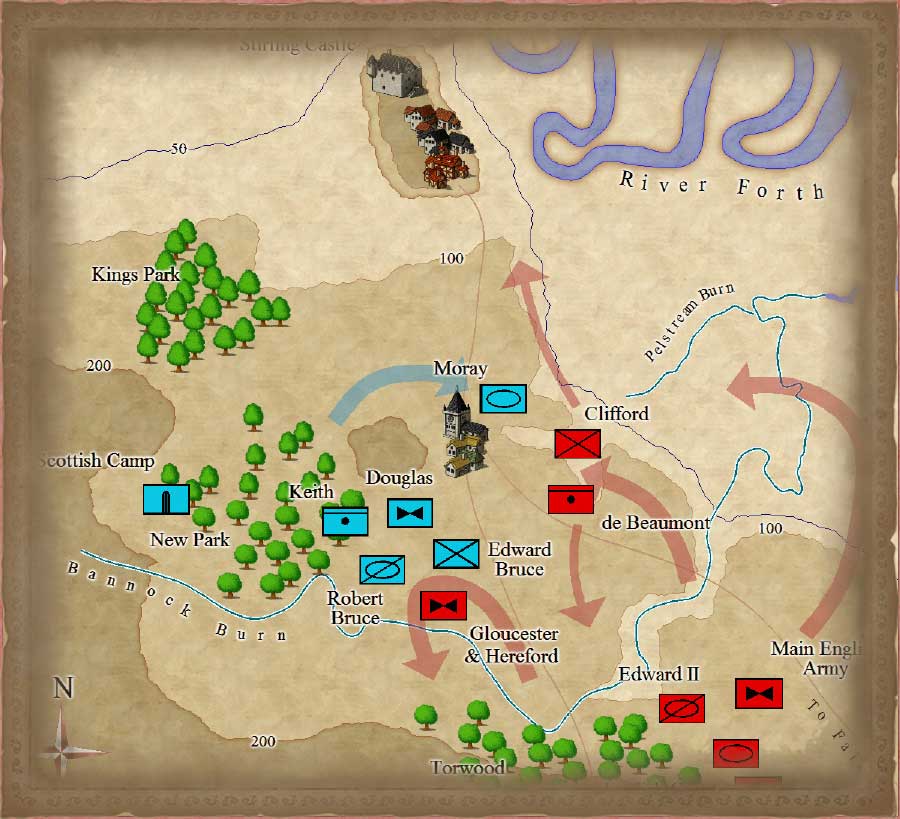
 he Scottish army was divided into several main sections. They were commanded by King Robert himself, Edward
Bruce the king's brother, Sir Robert Keith, Thomas Randolph the Earl of Moray and Sir James Douglas. Robert located his army
in the New Park forest to the left of the Roman road to Stirling. The land there was raised and was protected from the west
by the trees. From his position Robert could guard the road and look down on the Carse. Robert also laid a trap for the English.
Along each side of the road his men dug small pits and covered them with twigs and leaves. These pits were designed to cause
injuries to men and horses that stepped into them.
he Scottish army was divided into several main sections. They were commanded by King Robert himself, Edward
Bruce the king's brother, Sir Robert Keith, Thomas Randolph the Earl of Moray and Sir James Douglas. Robert located his army
in the New Park forest to the left of the Roman road to Stirling. The land there was raised and was protected from the west
by the trees. From his position Robert could guard the road and look down on the Carse. Robert also laid a trap for the English.
Along each side of the road his men dug small pits and covered them with twigs and leaves. These pits were designed to cause
injuries to men and horses that stepped into them.

Sir Philip Mowbray, the English commander of Stirling Castle came out to speak to Edward II. According to the terms of the agreement reached between Mowbray and King Robert, if Edward II had come within three leagues of the castle by midsummer's day the castle need not be surrendered and the armies need not fight. Those conditions had no been met and technically there was no reason to surrender the castle or fight. Edward II had no intentions of turning away after coming that far with such a large army and he wanted to deal with the Scottish king while he had the chance.
First Engagement
The opening engagement of the battle occurred when the English Earls of Gloucester and Hereford moved towards the Scottish lines. The knight Sir Henry de Bohun, the nephew of the Earl of Hereford, spotted the Scottish king who was inspecting the men on his forward battle lines. Sir Henry was in a group of cavalry or vanguard sent towards the Scottish lines to get more information about the enemy's position and number. When the knight saw Robert Bruce he saw his chance of fame and fortune and charged. But the knight's attack was badly timed and he missed the king. The Scottish king used the axe he was wielding to kill the knight with a single blow. The vanguard attempted to charge the Scottish who were arranged in a schiltron, a tightly packed rectangle of spearmen. The schiltron was too strong for the English cavalry and the English were beaten back and forced to retreat.
Attempt to reach the castle
Meanwhile an English force of around 300 knights2 lead by Sir Robert Clifford and Henry de Beaumont skirted the edge of the Carse and headed towards Stirling Castle either to relieve the troops there or to prevent the Scots retreating. They got as far as St. Ninians where they were intercepted by a Scottish schiltron lead by the Earl of Moray. Again the block of spearmen was too strong for the English and when another Scottish schiltron joined the fight led by Sir James Douglas the English were forced to flee. Some fled back to the English lines while the rest of the survivors managed to reach the safety of the castle.
The English advance
During the evening and night of the 23rd the rest of the English army crossed the Bannock burn onto the Carse. The ground was marshy so the crossing of the stream must have been a hazadous ordeal on horseback. The baggage wagons probably could not have crossed the marchy burn but the English army crossed and set up camp. Being midsummer the hours of darkness were short.
More maps
Map Index Page
Saxons and Angles
Invasion RoutesAreas Controlled in 550
Kingdoms in 7th Century
England in 1065
Vikings
Viking Invasions
William the Conqueror
Key battles in 1066Invasion of England
Possessions in 1087
By Date
Invasion France (1346)Invasion France (1415)
War of the Roses
Battle Maps
Locations by Area
Area map - North WalesArea map - Wales
Area map - South East
Area map - East
Area map - South West
Area map - North
Area map - Scotland Central
Area map - Scotland North
Area map - Midlands
Area map - South