By Category
By Category
Please note that the TimeRef website is currently being redesigned.
Timeline of Military Events (1100 .. 1199)

1100
Henry I granted the ownership of Carisbrooke Castle on the Isle of Wight to Richard de Redvers a Norman nobleman.
Gerard of Windsor built a motte and bailey castle on the Daugleddau creek in south Wales around this time. The land on which the castle was built was given to Gerard when he married Princess Nest. The castle is called Carew Castle.
1101
After Arundel Castle fell to the besiegers, the ownership of the castle passed to the King.
This is the start of a line of Bigod involvement at Framlingham where later a castle is built.
Ranulf Flambard escaped from the Tower of London and fled to Normandy. There he joined Robert II of Normandy who had just returned from the Crusades. Flambard and Robert planned to take the English throne away from his younger brother Henry I.
1102
The castle at Bridgnorth was surrendered to King Henry I.
The crusaders began the siege of the city of Tripoli in the County of Tripoli, now Lebanon. The siege was led by Raymond of Toulouse.
1103
Hugh of Saint-Omer, a crusader knight built Toron Castle to the east of Tyre. This is now known as Tebnine Castle.
The crusader Raymond of Toulouse had a castle built on Mount Pilgrim overlooking the city of Tripoli in order to lay siege to it.
1104
King Baldwin I captured the important port of Acre on the eastern coast of the Mediterranean. The port was an important supply route for Jerusalem.
1105
King Henry I entered Normandy to take power from this brother Robert whose incapacity to manage the affairs of the region could have had grave consequences. Robert fought back forcing Henry to return to England but not before Henry had gained Caen and Bayeux.
1106
Roger, bishop of Salisbury, was granted land in south Wales and started construction of a wooden castle called Kidwelly Castle on the banks of the river Gwendraeth.
King Henry I attacked his brother Robert at the battle of Tinchebrai. This time with a much larger force Henry defeated and captured Robert along with William, the Count of Mortain. Henry locked Robert in Cardiff castle where he remained until he died in 1135. Also captured was Edgar the Atheling who had sided with Robert. Edgar was released as King Henry did not think he was a threat.
1109
Nest, the wife of Gerald de Windsor, was abducted along with her children possibly from Cilgerrran Castle. She was abducted by one of her own relatives, Owain ap Cadwgan.
Jul 12
After a siege lasting many years Tripoli fell to the Crusaders. The Banu Ammar Emirs had an important library in the city but it was attacked and all the books were destroyed. The Crusader state of Tripoli was then founded, the last of the Crusader states. Bertrand of Toulouse, the son of Raymond IV, Count of Toulouse, became the ruler of the state alongside William-Jordan.
1110
At Aberystwyth in Wales an improved castle was built by the Norman Gilbert de Clare replacing an earlier fort. This castle was also known as Aberrheidol Castle.
King Henry I had improvements made at Windsor Castle, including a chapel, so that he could use the castle as his formal residence.
The construction of Krak des Chevaliers, an important crusader castle was begun in this year.
1113
A Papal Bull issued by Pope Paschal II (a formal proclamation issued by the pope) recognised and named the Knights Hospitallers of St. John of Jerusalem as an independent religious order.
1116
The Welsh led by Grufydd ap Rhys attacked both Llandovery and Carmarthen Castles.
1117
1119
Roger de Newburgh became the second Earl of Warwick.
1120
Kenilworth Castle's history began when Henry I gave a portion of the Stoneleigh estate to Geoffrey de Clinton his chamberlain. de Clinton built a motte and bailey on the land and formed a lake to provide better defences.
Built by Roger, Bishop of Salisbury.
1122
In retaliation for the removal of their trading rights agreed in the treaty of 1082 by the emperor of Byzantine, John II, the Venetians led by Doge Michiel began a long siege of the island of Corfu.
1123
Baldwin, the king of Jerusalem, was captured by Balak of Aleppo. To save the situation the Venetians were asked to help and so Doge Michiel lifted the siege of Corfu and took his fleet to Acre, arriving at the port in May.
The Venetian fleet arrived at Ascalon and instantly set about attacking the Egyptian fleet. The Egyptian fleet was totally destroyed or captured.
1124
Louis VI of France, with the help of his vassals, mobilized a huge number of men to avert a joint invasion from England and the Emperor Henry V.
Feb (to Jul)
The Crusaders laid siege to the city of Tyre in February and the city's inhabitants managed to hold out for five months before succumbing to starvation. The Crusaders were assisted by a fleet of ships from Venice.
1126
The tower-keep at Rochester Castle was built soon after 1126 by the Archbishop of Canterbury with the permission of King Henry I.
The castle at Shrewsbury was granted by Henry to his second wife Adeliza. The command of the castle was given to Fitz-Alan.
1127
Charles the Good, Count of Flanders, was murdered as he prayed in the church of Saint-Donatien at Bruges. His murder came as a huge shock and, as he did not have a son to inherit his title, the murder started a period of conflict in the region. Several claiments came forward including William of Ypres, Thierry of Alsace and William Clito. William Clito's claim was backed by Louis VI.
1129
1134
Robert Curthose, William the Conqueror's eldest son, died in captivity in Cardiff Castle where he had been locked up since being defeated by his brother in 1106. Robert was buried in Gloucester Cathedral where there is an effigy of him still.
1136
The Earl of Devon, Baldwin de Redvers took refuge in Carisbrooke Castle on the Isle of Wight after a defeat at the hands of King Stephen.
The Bishop of Lincoln built a castle at Banbury.
William le Gros built a castle on the headland at Scarborough.
Bampton Castle in Devon captured by King Stephen.
The Normans were defeated in battle at Crug Mawr, south west Wales, by a Welsh army. Cilgerran Castle then fell to the Welsh.
A peace treaty signed by King David of Scotland and King Stephen. The Scottish King had invaded northern England in January and had captured many of the major towns including Carlisle and Newcastle. In response, Stephen had raised a large army and marched north to Durham. King David agreed to talk rather than fight and an arrangement was agreed allowing the Scots to keep Carlisle in return for stopping their advance. David refused to do homage to the English King as his loyalties rested with Matilda, King Henry's daughter. King David's son did pay homage to Stephen and received the Earldom of Huntingdon in return.
After King Stephen gave up the rights to Cumberland after the Treaty of Durham to the Scots, King David made Carlisle his southern capital. The Scottish king made large improvements to the defences of the castle at Carlisle and built a keep.
1137
King Stephen sailed to Normandy to confront Geoffrey Plantagenet, count of Anjou and the Angevins who were attacking the southern areas of Normandy. Although Stephen had some success he was not able to deal fully with the count. Stephen did come to an agreement with the French King Louis VI and Eustace, Stephen's son, paid homage to the French king for Normandy.
1138
Robert, the Earl of Gloucester and half brother to Matilda (daughter of Henry I) rebels against King Stephen, supporting Matilda's claim to the throne of England.
Matilda was given refuge by William de Albini at Arundel Castle. King Stephen built siege works around the castle in response but was unable to break the castle's defences. Matilda escaped but was later captured.
Monks of the Savigny order were attacked by the Scots under the control of David I, and were forced to return to Furness Abbey.
King Stephen captured the castle at Shrewsbury. Henry (II) would capture back the castle before the end of Stephen's reign.
The Castle and lands around Dudley were attacked by King Stephen during the early part of his war against Matilda.
Ludlow Castle was captured on behalf of Matilda in 1138 and King Stephen besieged the castle in an attempt to regain it. During the siege the King bravely saved Prince Henry of Scotland from being injured by a grappling hook thrown from the castle.
Gilbert de Clare was made the first Earl of Pembroke. He took control of the castle of the same name.
King David of Scotland took an army across the border and attacked Northumbria. He wanted Northumbria for his son Henry.
In response to the Scottish attack in the north, King Stephen took an army into Scotland but the two kings did not meet and Stephen returned to England.
Robert, the Earl of Gloucester announces that he will assist Matilda, his step-sister in her claim for the English throne.
Led by their king, David I, the Scots invade and destroy Northumberland. The Scots moved south into Lancashire and North Yorkshire. This prompted Steven to mobilize an army to counter the invasion. The Scots captured and destroyed the important castle at Norham.
Aug 22
David I of Scotland was defeated at the battle of 'the Standard' in Yorkshire. The name for the battle came from the banners that were carried into battle by the English.
1139
After Brian fitz Count the owner of the castle at Wallingford sided with Matilda, King Stephen built two siege castles to force him out.
In 1139 Baldwin de Redvers captured Corfe Castle for Matilda. King Stephen besieged the castle but was unable to take it back.
King Stephen besieged Leeds Castle which was being held against him by supporters of Matilda. The castle fell to the King and he took control of it.
King Stephen arrested Roger, the Bishop of Salisbury. Bishop Roger was a powerful landowner and had several castles. Stephen also arrested Alexander, the bishop of Lincoln and had him imprisoned. Stephen wanted to take control to bishop Roger's castles and the bishop was taken to his castle at Devizes where he was held captive outside the walls and starved until the castle surrendered. Roger's son was also captured and tortured until the castle finally fell to the King. Roger's castle at Sherborne was also captured by Stephen. The castles at Newark and Sleaford in Lincolnshire belonging to bishop Alexander were forced to surrender to the King using the same underhand tactics.
Matilda arrives in England to further her attempts to take the throne from King Stephen. She was assisted by Robert of Gloucester, the illegitimate son of Henry I, King of England and a chief supporter of his step-sister Matilda's claim to the English throne.
1140
A castle at Sherriff Hutton may have belonged to Bertram de Bulmer .
A motte with a wooden tower was probably the first type of castle built by the Normans on the site. Hugh Bigod owned Framlingham at the time.
Built by the de Vere family, land owners in Essex.
The Norman Lord William D'Albini built a new stone keep at Castle Rising.
The Palace of Woodstock was held by Matilda's supporters during the conflict with King Stephen. Henry (II) spent much of his time there.
Lincoln, held by Matilda's supporters, was besieged by King Stephen. The siege would continue until February the next year.
1141
The castle was destroyed during the civil war.
Feb 2
Matilda's forces defeated and captured King Stephen at the battle of Lincoln. Stephen was held captive until September when Matilda's forces were defeated at Winchester.
After King Stephen had been captured at Lincoln, Matilda was elected as Queen of England at Winchester. Her new position as ruler of England was not to last for long
Matilda and her supporters entered London for her coronation. Her supporters included David I, king of the Scots. Geoffrey de Mandeville who controlled the Tower of London, abandoned his king as he saw Matilda had the upper hand. He joined her side and offered her the Tower of London. He did this to ensure he kept the Earldom of Essex which made him one of the most powerful barons of the time.
Sep 14
Matilda's forces were besieging a royalist held castle at Wolvesey near Winchester and were attacked and defeated by a royalist relief army. King Stephen who was being held captive at the time was exchanged for Robert, earl of Gloucester one of Matilda's supporters who was captured in the defeat.
Robert, Earl of Gloucester was held captive at Rochester Castle before being exchanged for King Stephen who had been captured earlier in the year at Lincoln.
1142
The Kinghts Hospitaller were given the massive castle Krak des Chevaliers by Raymond II, Count of Tripoli.
Oct (to Dec)
Oxford was besieged by King Stephen trapping Matilda inside the city. But just before Christmas Matilda managed to escape across the snow and ice of the frozen Thames dressed in white so that she would not be seen. Matilda escaped to Wallingford Castle and Oxford fell to the King.
1143
Three days after the death of Innocent II, Celestine was elected.
1144
Built by Robert, Earl of Gloucester. The castle soon came under siege by King Stephen who after four days took the castle and destroyed it.
After several years of conflict between the Angevins and the Barons of Normandy Geoffrey Plantagenet, count of Anjou, captured Rouen and took control of the whole of the duchy of Normandy. Geoffrey also took the title of Duke of Normandy.
Dec 24
The county of Edessa, a Crusader state, was captured by Zengi, ruler of Mosul. This triggered the Second Crusade in 1148.
1145
King Stephen captures the castle at Farringdon from Matilda.
Built by King Stephen (or the Earl of Chester). The castle had a moat and was situated on the site of current manor house.
The first formal Papal Bull of Crusade or 'Bulla cruciata' calling on France to restore the Holy Land to Christendom was issued by Pope Eugenius III, together with 'Quantum praedecessors' which was reissued on the 1st of March 1146.
1146
Llansteffan Castle was captured by the Welsh.
Pope Eugenius III reissued an amended Bull, a formal proclamation issued by the pope, proclaiming the Second Crusade.
Mar 31
St. Bernard's sermon at Vézelay so moved Eleanor of Aquitaine that she vowed to go on Crusade.
Dec 25
At the Diet of Speyer; the emperor Conrad III took the cross and secured the election of his son Henry as his successor in Germany. He was persuaded to take part in the crusade by the the Abbot of Clairvaux, St. Bernard.
1147
King Stephen leys siege to Pevensey castle and has to wait for the castle's reserves to run out before the castle falls.
Henry landed in England with a small army intent on attacking King Stephen. Unfortunately, Henry's army of mercenaries was small and they were not being paid enough. Stephen gave Henry money to pay the mercenaries and for Henry to return to Normandy. Henry left England.
May (to 1148)
The crusaders left Regensburg to march across land to Constantinople.
King Louis VII of France and his wife Eleanor of Aquitaine began their Crusade. They declared Abbot Suger regent of France,
The death of Robert was a blow to Matilda's attempts to fight for the English throne. Matilda was to leave England shortly afterwards.
1148
Without the support of the Earl of Gloucester, who had died the previous year, Matilda left England for Normandy leaving King Stephen to rule. His control over the country was limited due to his inability to subdue the lawless barons.
Jun 24
The decision was made to attack Damascus. The armies were assembled in Acre. Present were Baldwin, the Patriarch Fulcher, Kings Louis and Conrad, Archbishops of Caesarea and Nazareth, Masters of the Knights Temple and Hospital.
Hostilities between the French and German leaders of the Second Crusade became such a problem that the German Emperor, Conrad III, abandoned the crusade and returned to Constantinople. The Second Crusade ended in failure.
1149
King Stephen besieged then plundered the city of Worcester but was unable to capture the castle due to its strong defences. He expelled the Lord of the city William de Beauchamp. Stephen built two forts near the castle to assist in the attack. One was on Red Hill near Digly and the other was at Henwicks Hill.
1150
The keep at Portchester Castle was enlarged by raising its height.
1151
Louis VII, the king of France, was not happy with Henry's new position as Duke of Normandy. Louis declared war on Henry. But Louis fell ill and the two enemies did not meet in battle. The dispute was sent to arbitration in Paris (Knights Templar?) and was resolved by Henry doing homage to Louis for Normandy and giving France the area of Vexin.
1152
At the age of five or six, William Marshal was handed over to King Stephen as a hostage. Instead of being killed, which was possible, William began a new life that would make him a knight.
Prince Henry captured the town of Malmesbury and its castle.
After marrying Eleanor Henry came under attack by Louis, Eleanor's previous husband, who did not recognise Henry as the new Duke of Aquitaine. Stephen sent troops and his son Eustace to help Louis against Henry. Henry's younger brother, Geoffrey, was also not happy with the situation and joined the quarrels. Henry moved quickly attacking Louis and capturing Geoffrey to secure his position as Duke.
1153
Reading Castle destroyed by Henry II.
Richard de Lucy was appointed the title of Constable at the Tower of London, an extremely important position, by King Stephen.
Henry attacked Nottingham where a fire resulted in damage to the town.
Henry, the son of Matilda, and a fleet of 30 to 40 ships landed on the south coast of England. Henry chose to attack Malmesbury, one of King Stephen's outposts. The winter weather took its toll on Stephen's troops and a truce was agreed. The truce agreement was to have the castle at Malmesbury destroyed but this was not carried out and Henry took control of the fortress. Henry then went in search of supporters. In the Midlands, the Earl of Leicester took Henry's side and this gave Henry control of large number of castles.
King Stephen's son Eustace wanted to continue the fight against Henry and had started attacking areas around Cambridge and East Anglia. He ransacked the Abbey at Bury St. Edmunds but died very shortly afterwards from a sudden illness.
1154
King Henry II granted the castle at Berkeley to Robert Fitz Harding, a wealthy merchant who had helped Henry with financial aid during the conflict with Stephen.
At a meeting at Oxford the barons accepted Henry as the rightful heir to the English throne and paid homage to him. Henry was displeased because in the terms of the treaty of Wallingford many of the castles that had been built during the civil war were supposed to have been destroyed but were still standing.
Confident in his right to rule the country, King Stephen toured his kingdom. One of the pressing issues he faced were the numerous illegal castles that had been built during the Anarchy. In North Yorkshire a rebel held out against the king at Drax Castle. Stephen raised an army locally and captured the fortification.
1155
A plan to conquer Ireland was approved by Pope Adrian IV in a Papal Bull (a formal proclamation issued by the Pope) called Laudabiliter.
As part of his attempt to subdue the Barons who had become too powerful during the civil war, Henry took the castle at Scarborough from William of Aumale and Bridgnorth from Hugh Mortimer.
King Henry II captured the castle at Bridgnorth from Hugh de Mortimer who had taken possession of the fortress during the reign of King Stephen.
Orders were given to destroy the central tower at Farnham Castle. The castle belonged to Henry, Bishop of Winchester who was the brother of King Stephen.
The owner of Bolsover Castle, having murdered the Earl of Chester, forfeited his land to Henry II.
1156
1157
King Henry II rebuilt a castle at Basingwerk on the north coast of Wales overlooking a holy well. The king spent time at the castle while visiting the well.
The castle at Devizes passed into King Henry II's control.
King Henry II ordered a new castle to be built at Harbottle in Northumberland.
The castle at Wark-on-Tweed was refortified. King Henry II ordered a new stone castle be built on the site of the older wooden fort.
King Henry II invaded the northern territories of the Welsh Prince Owain Gwynedd. At truce was agreed and the Welsh Prince paid homage to English King.
1158
Welsh leader Ifor Bach attacked the castle and kidnapped William Fitzcount, the Lord of Glamorgan, along with his family.
1159
King Henry II claimed the area around Toulouse in the name of his wife Eleanor of Aquitaine, At Poitiers he gathered his army and on June 24th the army began its march. He invaded the region and advanced on the city of Toulouse. Louis VII of France was unhappy with Henry's increasing power and took an army to Toulouse to prevent the English king entering the city. As Henry was the vassal of King Louis he backed down from attacking the city while Louis was inside.
1163
King Henry II judged a trial by combat between Robert de Montfort and Henry of Essex. Henry of Essex was accused of cowardice being the flag bearer of the King who had dropped the flag and fled the battle. In his defence Henry said that he had heard incorrectly that the king had been killed. Robert de Montfort won the combat when it appeared that Henry of Essex had been killed. When the monks from Reading Abbey took Henry's body for burial they found that he was still alive and nursed him back to health. Henry of Essex became a monk at Reading Abbey.
King Henry II invaded Deheubarth taking Lord Rhys prisoner and confiscated his lands. Rhys was released a few weeks later. This prompted Lord Rhys to make an alliance with Owain Gwynedd, the Prince of Gwynedd to create an army to stand up to the Anglo-Normans.
1164
A large Norman square keep was built as Bamburgh castle as the cost of four pounds.
1165
King Henry II had confiscated Framlingham Castle from the rebellious Earl Hugh Bigod. But Hugh raised the money required to buy back the castle. Henry built the castle at Orford, a few miles to the south, to keep Hugh under control.
In an attempt to finally bring the Welsh princes under control King Henry II took a large army into north Wales. But the Welsh princes had combined their forces to create a single army of Welsh that matched the strength of the English. The Welsh had the advantage of terrain that they knew and this forced the English king to abandon his plans and return home.
1166
Dermot, the King of Leinster in eastern Ireland, was defeated in battle by Tighernan O Ruairc, another ruler in the region. Dermot was exiled and went to Normandy and the court of King Henry II of England to ask for assistance in retaking his lands. Henry gave Dermot permission to find a willing army from either England or Wales and so Dermot approached Richard de Clare, the Earl of Pembroke who agreed to help in return for several demands. These demands were Dermot's daughter's hand in marriage and to rule Leinster after Dermot died.
1167
Robert D'Oyley of Liseux built the castle at a strategic site of Wallingford where it was possible to cross the river Thames. Originally the castle would have been a motte and bailey type castle.
Dermot returned to Ireland but without an army. He was unable to retake Leinster and had to wait until the forces he had been promised arrived from Wales.
1168
King Henry II ordered the reconstruction of Dover Castle. The work would continue for twenty years and at the end of it, a brand new keep had been built, along with the outer walls of the inner bailey and sections of the outer wall.
1169
Some the men promised to assist Dermot in Ireland landed at Bannow with the sons of Nesta. The poorly protected Irish warriors were no match for the armoured knights and archers that arrived from Wales. By the end of the year Leinster fell and Dermot once again became the King. After his victory Dermot was not satisfied with just ruling Leinster but wanted to become High King of Ireland. To fulfil his ambitions he had to wait for the arrival of Strongbow, the Earl of Pembroke, for that to be a possibility.
1170
Middleham Castle in Yorkshire could have been built at this time.
Raymond de Gros arrived in Ireland in support of Dermot a few months ahead of Strongbow. He landed at Waterford and constructed a fort in which he and his men prepared for the arrival of the Earl.
Richard de Clare, the Earl of Pembroke, invaded Ireland with 200 knights in armour and up to a 1,000 foot-soldiers capturing Waterford easily and then Dublin on behalf of Dermot, the King of Leinster.
After letting the population of Dublin leave, the Earl of Pembroke and his men spent the Winter in the city.
When King Henry II heard that Thomas Becket had returned to England and was threatening to excommunicate his opponents, his outrage was such that four knights overhearing the King travelled to England and killed Becket inside Canterbury Cathedral.
1171
King Henry II financed the construction of an improved Bowes Castle on an old site in County Durham.
King Henry II granted territories of south Wales including Cardiganshire to Rhys, the Prince of Wales.
The agreement between the Earl of Pembroke and Dermot, the King of Leinster, was that if the Earl helped the King retake Leinster the Earl would become the ruler of Leinster when Dermot died. When the king died in the spring of 1171 the agreement fell apart due to the lack of support from Dermot's tribesmen. The tribesmen elected a nephew of Dermot's as the new king instead.
King Henry II had become concerned that Strongbow was building a strong base in Ireland, strong enough to become an independent state separate from England. Henry planned to take an army to Ireland to deal with Strongbow but Strongbow travelled to England and in September met Henry and promised his loyalty to the King.
King Henry II travelled to Ireland to receive the homage of the Irish leaders. Traders were invited to Dublin where a colony of English was set up. Henry stayed in Ireland over the winter months returning to England in the spring of 1172.
1173
Repairs to the castle at Wallingford.
King Henry II carried out major rebuilding work at Windsor Castle, including raising the height of the keep and improved the walls around the bailey. He added towers to the walls and built himself a house, the basement of which survives.
With the threat of attack from the Barons and his own sons, King Henry II took control of Kenilworth Castle and defended it with a small army of men.
King William of Scotland targeted several key fortifications in northern England, particularly in Northumberland and Cumberland in an attempt to seize territory while King Henry II was preoccupied with the broader revolt against his son. Castles that he attempted to capture included Carlisle Castle, Newcastle Castle, Prudhoe Castle and Alnwick Castle. All of these castles managed to be defended against the Scottish King's attacks and sieges.
King William of Scotland allied with Henry II's rebellious sons, particularly Henry the Young King, to weaken Henry's hold on England. William crossed the English border with his forces, leading raids into Northumberland and Cumberland attacking English towns and castles, but was bravely pushed back by supporters of the King of England. In the autumn, after causing widespread disruption, William withdrew to regroup for a renewed offensive in spring 1174.
1174
Bolebec Castle near Whitchurch was built around this time by Hugh de Bolebec.
King William of Scotland was held captive at Richmond Castle.
Richard seized the town of Saintes from his father but soon lost it again as Henry's tactics and forces were more superior.
Jun 13
William I, king of Scotland invaded England to help fight in the baronial rebellion against Henry II. The Scottish King attacked the castle at Prudhoe but was unable to capture it. William was captured at the Battle of Alnwick and the rebellion came to an end. He was transported to Falaise in Normandy where he would later sign a peace treaty.
From the middle of July King Louis of France, Henry the Young King and Philip the count of Flanders had surrounded the city of Rouen. The city held out against the war engines long enough for Henry II to arrive in the middle of August to stage a rescue. The besiegers were fearful that King Henry II would invade France and the siege was lifted.
After a year and a half of rebellion against him, King Henry II achieved peace agreements with Louis VII the French king and his own three sons. (Treaty of Falaise?)
Captured by the English, William I of Scotland was forced to sign the Treaty of Falaise. The treaty made Scotland a feudal possession of England and William and his nobles swore fealty to Henry II. William had to hand over several castles to the English in return for his freedom. One of these was Stirling Castle. This treaty was overruled by King Richard I in return for funds paid by Scotland that Richard needed for his crusade in 1189.
1175
Abergavenny Castle was captured from William de Braose by Sitsyllt ap Dwfnwal, a Welsh Chieftain. The castle was restored to Braose by Sitsyllt and the Chieftain was invited to a feast to celebrate its return. Instead of a friendly meeting Braose had Sitsyllt ap Dwfnwal and his guests murdered.
Oct 6
The Treaty of Windsor was signed by King Henry II and Rory O'Connor allowing O'Connor control of the areas of Ireland other than Leinster, Meath, Waterford and Dublin which were controlled by the English King. O'Connor agreed to pay Henry an annual sum of money and to provide one hide from each ten animals slaughtered every year.
1176
A square central keep was constructed at Peveril castle which was under the control of Henry II.
Richard 'Strongbow' fitzGilbert de Clare, Earl of Pembroke died in Ireland.
1177
Carrickfergus Castle was built by John de Courcy, the Norman knight who invaded and conquered the Irish region of Ulidia (Ulster).
John de Courcy, a Norman knight with an army of around 320 men from Dublin, attacked the area of Ulidia now Ulster and captured its capital town Downpatrick. The king of the area, MacDunlevy, attempted to retake the town but was beaten back by de Courcy.
MacDunlevy, the native king of Ulidia (Ulster), was joined by the king of a neighbouring district and raised a large army to retake Ulidia from John de Courcy. They were also joined by several Irish bishops and many clerics. But the army was not able to defeat Courcy who then became lord of Ulidia.
1179
Within two weeks Richard broke the defences of the fortress town of Taillebourg. King Henry II employed his son Richard to bring the rebellious barons of the Aquitaine area under control.
1180
The massive keep at Kenilworth was under construction during this period.
Built by Hamelin Plantagenet, Henry II's brother.
Jun 28
A non-aggression treaty signed between Philippe Augustus and Henry II.
1181
This law was passed to force all freemen to arm themselves according to their wealth with weapons and equipment in order to protect their homes and country from invaders.
1182
Henry de Clinton exchanged Kenilworth Castle for other land?
In 1182 Abergavenny Castle was invaded by the sons of Sitsyllt in revenge for the death of their father.
Dingstow (Dingestow) Castle was under construction by 1182, in the form of a motte and bailey. Located near Monmouth in south Wales.
1185
John accepted the post of Lord or Ireland and travelled there to take control. He was around eighteen years old and took his friends of the same age with him. They treated the native Irish barons with contempt and the English soldiers were unable to subdue the Irish fighters in unfamiliar conditions and the mission soon became a complete disaster. By the end of the year John returned to England. William Marshal, the Earl of Pembroke was entrusted with the task of controlling Ireland.
Signed by Philippe Augustus to ensure his authority over his vassals.
1187
To avoid war with Philippe Augustus, after Philippe had taken Issousun, King Henry II signed a peace treaty at Chateauroux.
After a short siege Saladin captured the port of Acre from the Christians.
The Christian Army of Jerusalem was beaten by Turkish forces at the Battle of Hattin. Guy of Lusignan was King of Jerusalem at this time. All Knights Templars and Hospitallers who survived the battle were executed afterwards. The Archbishop of Tyre, a man called Josias, was dispatched from the city to Europe to inform the Pope and European leaders of the disaster that had taken place and to ask for help.
Jerusalem fell to the Muslims and the al-Asqu mosque was returned to Islam. The Muslims allowed four Christian Priests to hold services in the Church of the Holy Sepulchre. This was in contrast to the first Crusaders who since they first captured the city in 1099 had treated Jerusalem as theirs alone. The Muslim leader was Al-Malik al-Nasir Salad ed-Din Yusuf also known as Saladin.
King Richard took the Cross. Before going on a Crusade a vow was taken and the person was given a piece of cloth in the shape of a cross to be sown onto the surcoat. To go on a Crusade meant a person was granted a plenary indulgence which freed them from the terrors of purgatory and hell if they killed the enemy and gave them the promise of eternal life in heaven.
1188
Summer
The conflicts between England and France started once again with King Henry II attacking French lands and Philippe II attacking English lands in Normandy.
Unhappy that King Henry would give the throne of England to John, Richard sided with Philippe Augustus of France.
1189
While Richard I was away on Crusade, William Longchamp, the Bishop of Ely and Chancellor ordered the enlargement of the bailey surrounding the keep Tower in London. A new ditch and bank were constructed with a new section of curtain wall.
The Order of the Teutonic Knights established at Acre.
In 1189 William Marshal married Isabel, the heiress of Earl Richard de Clare. Isabel's castles passed to William including Pembroke Castle.
Richard, joined forces with the French King to attack his own father.
King Henry II was now seriously ill and submitted at a conference with the French King to peace. Henry agreed to do homage to Philippe and several towns and castles were taken by the French. It was now that Henry learnt of John's allegiance with the French King and this news upset the English King so much it was a major cause of his death.
William I of Scotland gave Richard I of England 10,000 marks for the Crusade. This overturned the Treaty of Falaise which William had to sign when captured in 1174.
1190
Built by Hubert de Burgh this castle is one of the three he owned in the Welsh Marches. White Castle, and Grosmont Castle being the other two.
In this year Rhys ap Gruffydd, The Lord Rhys captured the castle at Kidwelly from the Normans. It is possible that he repaired its structure at this time.
A group of German knights on crusade during the siege of Acre formed an Order to assist sick pilgrims travelling to holy land.
The large army of German crusaders marched towards Constantinople on the way to the Holy Land. But Isaac II, the Byzantine Emperor, had sided with Saladin and was attempting the stop them by attacking the crusaders. But the German army was too strong and they captured Adrianople. A peace treaty was signed by Isaac and Frederick of Germany, the crusaders' leader, that ensured the Germans were given supplies and free passage through to the Holy Land.
Even though the Jews were under special protection from King Richard I, because of their wealth that could help pay for the Crusades, the mob attacked 150 Jews hiding in the castle at York. Most committed suicide rather than be attacked by the mob, but the rest believing promises that they would be spared if they came out left the castle and were promptly massacred. The castle, made only of wood at this time was destroyed by fire during the disturbances.
Jun 24
Richard was given the pilgrim's scrip (a bag for the journey) and staff by the archbishop of Tours in preparation for his Crusade. These items were traditionally carried by pilgrims.
Jul 3
King Richard I of England and King Philippe II, Augustus of France, met at Vézelay and agreed to divide the spoils of the Crusade equally between themselves. They planned to take different routes, Richard via Marseilles and Philippe via Genoa. Richard had around 100 ships at his disposal, several of which were from the Cinque Ports, others from Shoreham and Southampton and more donated by private persons. Other ships were hired from ports in Normandy. Richard could have had a force of around 8000 men half of which could have had horses.
Richard leaves to begin his crusade.
Sep
Richard was in no hurry to reach the Holy Land as he had an issue to resolve in Italy first. William II, the King of Sicily, had recently died. He was married to Richard's sister, Joan, who was bequeathed a large dower, a payment meant to support her if she outlived her husband. William had also bequeathed a large sum of money to Henry II, the king of England. Through force, Tancred of Lecce claimed the throne of Sicily and imprisoned Joan refusing to pay the money to her or the King of England. When Richard arrived in Messina he demanded that his sister should be released and all the money owing should be paid.
The people of Messina, supporting Tancred, shut the gates on Richard and attacked his soldiers. In the harbour French ships turned against Richard as the friendship between Richard and Philippe had broken down because Philippe believed Richard was about to refuse to go through with his marriage to Alais, Philippe's half-sister. This was true as Richard had arranged a marriage to Berengaria of Navarre who was travelling to meet him. Richard's men stormed Messina and captured the town. Richard was lenient on the people of Messina and decided to build a fort overlooking the town. Tancred agreed to pay the money owed, freed Joan from prison and paid Richard a large amount of gold. Friendly relations were restored between Richard and Philippe when Richard agreed to split the gold with the French king.
Christmas
Richard and Philippe stayed in Sicily over the winter months waiting for the weather to improve before continuing their journeys to the Holy Land.
1191
John began a campaign opposing William Longchamp who had been appointed administrator of England by Richard I while he was away on Crusade.
Mar 30
The King of France set sail for the Holy Land a few days before Richard.
The fleet left Sicily to sail to Rhodes. On route, three ships were separated from the group and landed on Cyprus at the port of Limassol. The governor of Cyprus at the time was Isaac Dacus Comnenus, who had come to power from trickery. He had sided with Saladin, and treated Richard's ships as the enemy.
Philippe Augustus landed in Acre in an attempt to remove Guy of Lusignan as the King of Jerusalem, and replace him with Conrad of Montferrat.
Richard located the three lost ships at Limissol, and promptly attacked Comnenus' troops in the town and drove them out. Comnenus was again attacked outside the town, but escaped, leaving behind his standard, embroidered with gold cloth. This was later presented to the abbey of Bury St. Edmunds.
May 11
King Richard I met Guy of Lusignan (King of Jerusalem), Geoffrey (Richard's brother), Bohemund (Prince of Antioch), Raymond (Count of Tripoli), Humphrey of Toron and other knights to discuss the attempt by Philippe II of France to replace Guy of Lusignan with Conrad of Montferrat as the King of Jerusalem.
By the 1st of June, Richard had control of the whole of Cyprus and imposed a 50% tax in return for letting the Cypriots return to a more traditional way of life. Richard of Camville and Robert of Turnham were left in charge of Cyprus.
King Richard I landed at Tyre and quickly moved towards Acre, where he needed to help an army that was besieging the town which was being held by a garrison of Saladin's troops. By July 12th, the town fell to Richard. Richard held Saladin's men hostage in exchange for 200,000 dinars and the release of 1500 of Richard's own troops who were being held by Saladin. When no ransom was paid, Richard publicly executed 2700 of the garrison. It was at this point that Richard angered Leopold of Austria, who was to imprison Richard as he tried to return to Normandy. Leopold's banner was ripped down from alongside Richard's and the French. The banners indicated that the spoils of war should be shared, but Richard was not prepared the share with Leopold, who had not contributed to the fall of Acre.
Under Richard's command, the city of Acre is taken back by the Crusaders.
Bishop William Longchamp held the Tower of London against Prince John's supporters for only three days. The Bishop surrendered the Tower and escaped to continue his support for King Richard.
1192
William de Camville had been granted Llansteffan Castle by King Henry II and rebuilding work started in 1192.
Apr 28
Conrad of Montferrat was killed by two Assassins disguised as monks as he walked home. The Assassins, one of whom had been captured alive and questioned, had been sent by their leader Sinan. The suspected reasons for the murder are varied, some theories suggest Conrad had intercepted a shipment of wealthy goods bound for the Assassin Order while others suggest Saladin had ordered the murder of both Conrad and Richard I. Some also suggest it was Richard himself who had ordered the murder.
Word reached Richard that a Moslem caravan rich with supplies was heading for a well known as the Round Cistern. The caravan was not expecting an attack and the Christian army managed to capture a large amount of rich merchandise, horses and camels.
Sep 2
Richard the Lionheart signed a peace treaty with the Moslem leader Saladin.
1194
The castle at Nottingham was being held by supporters of John but it fell to Richard I after a siege of several days.
In Nottingham a council was called to hear the King's request for raising taxes. Although a large amount of money had been raised to free him from Germany even more was raised to fund Richard's expedition to France to deal with the King of France. Once the money was raised Richard left England and was never to return.
On his return from imprisonment, Richard declares war on Philippe Augustus and defeats him at Fretevel. All the French archives were destroyed in the battle which were being transported in a wagon behind the army.
1197
At the Great Council King Richard I requested that 300 knights should be given to him for a years service in France. The Great Council refused.
After the death of Rhys ap Gruffydd, Lord Rhys, his eldest son Gruffydd ap Rhys was generally accepted as his successor, but not by his brother Maelgwn. With the help of Gwenwynwyn ap Owain, the ruler of the areas around mid Wales, Maelgwn invaded the lands of South Wales controlled by Gruffydd his brother. The invaders managed to capture the town and castle at Aberystwyth.
1198
Gwenwynwyn ap Owain exchanged his prisoner, Gruffydd ap Rhys, for a castle(?). Gruffydd ap Rhys was transferred to Corfe Castle. Maelgwn extended his control over the South or Wales.
1199
The Order of the Teutonic Knights is approved by Pope Innocent III.
Richard besieged the castle at Chalus where some treasure had been unearthed. Richard believed it was his and tried to take the castle. Riding too close to the walls, Richard was shot in the shoulder. The castle then fell and the archer who shot Richard was brought before him. Richard forgave the archer but Richard's second in command had the archer executed. Richard died of his wounds. On his death bed, Richard nominated his brother John as his heir rather than Arthur of Brittany. Richard was buried at Fontevraud Abbey.
Jun 20
King John, along with many nobles, knights and soldiers, left England from Shoreham and sailed to Normandy. Within a few days John and Philip agreed a short peace treaty to last until the middle of August.
A Medieval Mystery
There appear to be some strange connections between the fourteenth century Old Wardour Castle and ancient stone circle Stonehenge.
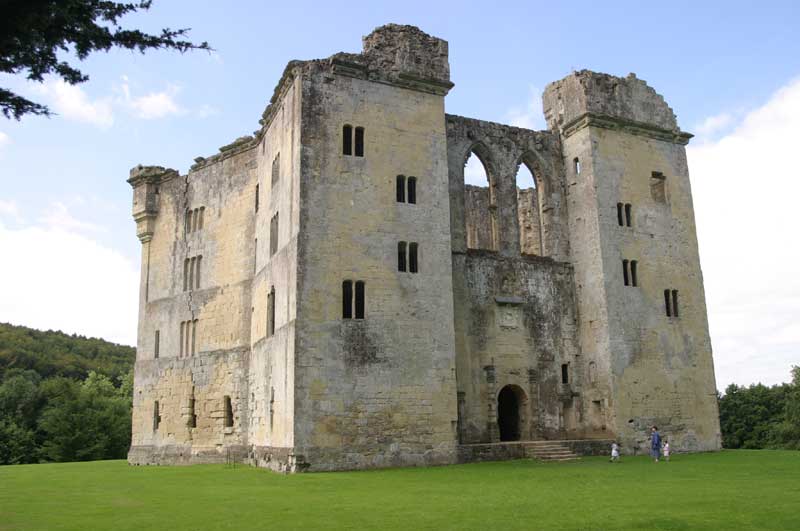
1: Location
Old Wardour Castle appears to be aligned to ancient sites in the Stonehenge landscape.
2: Alignment
Stonehenge is aligned to the Summer Solstice. Old Wardour has a very similar alignment.
3: Size
Could the builders of Old Wardour used mesaurements from Stonehenge to layout the geometrical keep?
Learn More