By Category
By Category
Please note that the TimeRef website is currently being redesigned.
Timeline of Religious Events (1200 .. 1299)

1200
Work began on the Lincoln Cathedral's main West transept, or Great transept in 1200.
The early cathedral at Rouen in France was badly damaged by a fire that destroyed other churches and parts of the city as well.
1201
This Cistercian abbey in Devon was founded by William Brewer.
Valle Crucis Abbey in North Wales was founded in 1201 by Madog ap Gruffuud Maelor.
1202
The Fourth Crusade (1202–1204) was originally intended to recapture Jerusalem from Muslim control, but the goals of the crusade were controversially changed by Venice in order to gain new territories and ended in the sack of Constantinople, the capital of the Byzantine Empire. It demonstrated how crusading motives could be manipulated for political and financial gain rather than religious purposes.
Construction work began on the retrochoir, the area to the east of the presbytery, and the Lady Chapel of Winchester Cathedral. Work continued until 1235.
The devastating fire in this year caused so much damage to the cathedral that the building needed to be rebuilt.
1203
Founded by King John who wanted to become an object of prayer by the Cistercian order. The abbey was built on the site of a hunting lodge in the New Forest and was colonised by monks directly from Citeaux.
1204
Eleanor, Henry II's wife and John's mother died. Eleanor was buried at Fontevraud Abbey .
1205
When Hubert Walter died a dispute began between King John and the monks of Canterbury over who should become the new Archbishop of Canterbury. King John wanted John de Grey, Bishop of Norwich, to have the position but the monks wanted their sub-prior, Reginald. The matter was delayed until December when a mission sent to Rome could consult the Pope. Reginald himself went as part of the mission and stated that he had been elected by the monks. When King John heard of this he demanded that De Gray should be elected and the monks dutifully did.
1206
Although the monks of Canterbury wanted their own sub-prior for the post of Archbishop and King John wanted John de Gray, Pope Innocent III chose Stephen Langton. Langton was originally from Lincolnshire but after teaching in Paris had moved to Rome where he had become a Cardinal. The monks of Canterbury accepted the Pope's decision and voted Langton in as the new Archbishop. King John did not agree.
1207
Stephen Langton was chosen as Archbishop of Canterbury by Pope Innocent III.
King John took the land of the Earl of Leicester (father of Simon de Montfort) and banished him from England.
The Pope threatened King John with the sentence of Interdict unless he accepted Stephen Langton as Archbishop of Canterbury. An Interdict meant that church services would be banned in England except for baptisms and confessions.
Christmas
King John visited Worcester and gave funds for the rebuilding of the Cathedral after the devastating fire.
1208
After the nave was completed construction work commenced on the west front of Notre Dame Cathedral under the direction of Pierre de Nemours.
Peter of Castelnau, the papal legate, was murdered by heretics belonging to the Albigensains. The Albigensains were an extreme religious group based in the south of France. The Pope wanted them to cease their opposition to the Church. The murder led to the start of the Albegensian Crusade that would destroy the heretics.
1209
Stephen Langton landed at Dover from France to see King John and took the position of Archbishop of Canterbury. John refused to meet with him although John did meet Stephen's brother Simon.
Jul 22
The Albignsian stronghold of Beziers was besieged and when it was captured all the people within it were massacred.
King John is excommunicated by Pope Innocent III.
1210
Rebuilding work of the eastern parts at Fountains Abbey.
1211
In the previous year the cathedral at Reims was left beyond repair after a fire. Archbishop Aubry de Humbert ordered its reconstruction from the ground up.
Aug 30
In Northampton the Papal legates Pandulf and a Knight Templar met King John after his return from Wales. They had been sent by Pope Innocent in an attempt to get the English king to see the error of his ways but when they failed they served King John with his excommunication. For John this was a serious blow to his ability to rule the country as it absolved the King's subjects from their oaths of allegiance, gave the Barons reason to revolt and allowed the King of France to invade England to remove John from power.
1212
A mysterious Crusade supposed to have consisted of children from Germany and possibly France. How young the children were who took part is not known and they may not have been children at all. The Crusaders did not get very far and many of those that took part never came back. They were either killed or sold into slavery.
Taking the advice of William Marshal John accepted the demands of the Pope and that Stephen Langton should become Archbishop. A peace mission was also sent to the Pope.
1213
King John made his first act of submission to the Pope's envoy at Temple Ewell after the papal legate Pandulph asked members of the Knights Templar to arrange the meeting. Temple Ewell was a Templar preceptory located near Dover.
Jul 20
When King John agreed to meet Stephen Langton at Winchester he was absolved from excommunication.
Cardinal Nicholas De Romanis arrived in England to prepare for the settlement of the Interdict. John's punishment was to pay 100,000 marks to compensate the church for the losses he had caused it.
King John appeared at St. Paul's Cathedral in a second act of submission to the Pope.
1214
This Cistercian abbey near Peterhead in Scotland was founded by monks from Kinloss.
A new location for this Cistercian abbey was found near Leek in Staffordshire.
Jun 29
At St. Paul's Cathedral, in London, the Interdict was finally lifted.
1216
Pope Innocent III died on July 16th and two days later in Rome the Cardinals elected Honorius III as the new Pope.
King John's wishes were to be buried at the cathedral at Worcester due to his affection for the late saint Wulfstan who was buried there. This was done and King John's body was placed in a tomb at the centre of the Cathedral.
1217
Again Egypt was the destination of this Crusade called for by the Pope and organised by Frederick II, the Holy Roman Emperor. Although Frederick promised to join the Crusade he failed to do so. The Cruaders mainly consisted of Knights from northern Europe. They laid siege to Damietta, a port on the Egyption coast, and captured it. The journey from Damietta to attack Cairo had to be abandoned due to floods and attacks. The Crusaders had to surrender and Damietta was handed back to the Muslims. The Crusade was over and Frederick II was blamed for its failure.
Cluross Abbey, in Fife Scotland, was founded by this year by Malcolm, the Earl of Fife.
1219
The Cistercian Deer Abbey in Aberdeenshire, Scotland, was founded by William Coymn, the Earl of Buchan. It was populated with monks from Kinloss.
1220
A new site 2 miles from the original site at Old Sarum was chosen for the new Salisbury Cathedral. For a cathedral the construction work was completed in a very short time and the building was consecrated in 1258 only 38 years later.
The Lady Chapel of Salisbury Cathedral appears to be the starting point of the construction of the new cathedral. Work continued until 1225.
Work began on the Lady Chapel at Oxford Cathedral. The chapel was incorporated into the layout of the Cathedral as an extra aisle built onto the north side of the building.
The central tower collapsed at St. David's Cathedral destroying the presbytery resulting in construction work to repair the damage.
Building work on the Beverley Minster began in this year. The building was designed using the Gothic style and construction work continued until 1425.
Construction of the Elder Lady Chapel commenced in 1220 and took around ten years to complete.
Construction began in 1220 under Bishop Evrard de Fouilloy and was largely completed by 1270. The cathedral was built to house the relic of St. John the Baptist's head, a prized Christian relic acquired during the Crusades, which attracted pilgrims and contributed to its rapid construction.
At his coronation in Westminster Abbey, King Henry was reminded of his duties at king to maintain peace, defend the rights of the crown and to dispense justice where required. Henry was only around thirteen years old. The day before the coronation Henry laid the foundation stone of a new Lady Chapel at the Abbey.
Stephen Langton returned to England and resumed the role of Archbishop of Canterbury. He performed a ceremony in Canterbury in which relics from St. Thomas Becket were put in a tomb. The 7th of July became St. Thomas of Canterbury's Day; a major holy day.
1221
Stephen Langton, Archbishop of Canterbury, travelled to Rome and left Hubert de Burgh in charge of affairs of the country.
At York Minster, King John's daughter Joan married Alexander II, the king of the Scots. Joan was only eleven years old at the time of the wedding.
1223
A fire destroys part of the abbey church at Pershore.
1225
1226
Building work on the South Transept of York Minster took place until 1241. It was directed by Archbishop Walter Grey and was executed in the Early English style with five lancet-shaped windows known as the Five Sisters.
Grace Dieu Abbey was founded in this year. It was a daughter house of the Cistercian abbey at Dore near Hereford. The foundation would have been earlier but the abbey was attacked and burnt by the Welsh in 1223. The abbey was situated near Monmouth, but no real remains can now be seen.
1227
The Scottish Cistercian abbey is situated on the shores of the Firth of Tay. It was founded by the widow of William the Lion of Scotland and her son Alexander. It was built quickly and the monks from Melrose arrived before the end of 1229. The cloister is built on the north side of the church.
1228
The Sixth Crusade was won with diplomacy by Frederick II, who had married the heiress of Jerusalem in 1225. He went to the East to claim his right to the throne, and taking advantage of internal disputes between the Sultan's family members, concluded the Treaty of Jaffa, which gave Jerusalem, Bethlehem and Nazareth back to the Christians.
On the death of Stephen Langton, the Archbishop of Canterbury, the Pope, attempting to raise as much money from the clergy in England filled senior posts in the clergy with anyone who bidded the highest.
1230
Building of the West Front of Wells Cathedral was begun.
Work commenced on the West Front of Wells Cathedral.
Rebuilding work commenced at Rievaulx Abbey.
1232
King Henry III donated one hundred and ten oaks from the forest of Dean to help in repair work at Gloucester church.
Lacock Abbey in Wiltshire was founded by Ela, Countess of Salisbury, the widow of William Longespee, the son of Henry II.
1236
Canterbury Cloister building work.
Pope Gregory IX condemned the links that both the Knights Templar and Knights Hospitaller had with the Assassin fighters in the Middle East. He issued a Bull, a formal proclamation issued by the pope, preventing further contact with the Assassins.
King Henry III married Eleanor, one of four daughters of Raymond count of Provence. Eleanor was 14 years old. Simon de Montfort, as Lord High Steward, took care of the banquet and kitchen arrangements. The ceremony took place at Canterbury Cathedral.
1237
During a sermon by one of the canons of the cathedral, the newly finished central tower collapsed burying some of the congregation.
1238
Simon de Montfort married King Henry III's sister, Eleanor secretly. She had been married to William, Earl of Pembroke (son of William Marshal?), but he died at a young age and left her with his wealth. The Barons were not happy with this arrangement as they were not consulted.
1239
The Crusade of Theobald of Champagne and the King of Navarre was a French expedition that did little, except obtain concessions from Damascus in Galilee, and Ascalon from Egypt. Richard of Cornwall, the brother of King Henry III, arrived after Theobald had left, but managed to strengthen both concessions in Galilee, and the fortifications at Ascalon.
The church at Wells was dedicated in this year, but did not get its status as a Cathedral until 1244.
1240
In London, the central tower and the choir of St. Paul's had been rebuilt during the first part of the thirteenth century and by 1240, building work was completed. Some changes were made at the end of this century, but then no major alterations occurred until after the Reformation.
The Chapter-house at Lichfield has two storeys, the lower one for the meetings and the upper one for the library. The building is roughly octagonal in shape, but two sides are double the length of the others.
1241
Celestine IV was elected as the Pope but only reigned for seventeen days before his death in November.
1242
Building work on the North Transept of York Minster took place until 1255. There a five slender windows in the north wall of the trancept that are known as the Five Sisters of York.
During a violent storm at sea, Richard, Earl of Cornwall, vowed to build a Religious house if he survived. He did survive and as a result Hailes Abbey was built.
1243
1244
The Pope decreed that Wells should be reinstated as a Cathedral and the Bishop became the Bishop of Bath and Wells.
With the fall of Jerusalem and the crushing defeat of the Christian armies at Gaza, Louis IX of France took the cross and prepared for a Crusade. It took him four years to set sail.
1245
Carpini, a Christian envoy travelled to the seat of the Mongol Emperor at Karakoram and another, Roubrouck followed in 1253.
Henry started the work of rebuilding Westminster Abbey as a tribute to Edward the Confessor.
Work on the choir, aisles and arcading began at Carlisle Cathedral and construction lasted until 1292 when a fire badly damaged the Cathedral.
1246
Twenty monks and ten lay brothers (monks who performed manual tasks) arrived at Hailes to start work on the new Abbey.
The Cistercian abbey at Beaulieu, founded earlier by King John, was dedicated in the presence of King Henry III, Queen Eleanor and Prince Edward.
1247
Henry received a relic from the patriarch of Jerusalem consisting of a portion of the blood of Christ in a crystal vase. Henry walked with the vase in his hands clothed in a course robe from the treasury in St. Paul's to the church of Westminster where mass was said. He was assisted by attendants on both sides in case he slipped and dropped the vase.
1248
After the Christians were defeated at Gaza in 1244, King Louis IX of France took the cross. He only managed to set sail for Cyprus some four years later, landing at Damietta in June of 1249, Louis had to wait until the Nile floods had reduced before continuing for Cairo. Held up and cut off from Damietta, the French King's camp was struck with disease and most of his men were killed or captured. Louis was taken prisoner and had to pay a ransom to be freed.
1250
After several years and many petitions to Rome, the body of Queen Margaret, the wife of Malcolm Canmore, was moved from its position in Dunfermline Abbey to a more prominent position nearer the altar. The Queen was canonised as a saint.
1251
The King and Queen, with Richard, Earl of Cornwall (the King's brother) were at Hailes Abbey for its dedication ceremony.
King Henry III's daughter Margaret married Alexander III, king of the Scots, at York Minster. Both bride and groom were under the age of eleven at the time of the wedding. The festivities were huge as many members of the English and Scottish courts attended the wedding.
1252
A shrine to St. Ethelreda was installed in the retrochoir of the cathedral at Ely. The ceremony was attended by King Henry III and many other dignitaries.
1254
At the age of fifteen Prince Edward traveled from Portsmouth with his mother and the Archbishop of Canterbury to marry Eleanor of Castile the half-sister of the King Alfonso X of Castile. Both Edward and Eleanor were descended from King Henry II. They arrived in Burgos, the capital of Castile, in August where the marriage was due to take place.
1255
Work began on the construction of the Angel Choir at Lincoln Cathedral in order to house the body of St. Hugh. Work was completed in 1280. The celebration of the movement of the body was attended by King Edward I, the Queen and many important figures of the time.
After the marriage at a Cistercian convent in Castile, Edward and Eleanor returned via Dover to England. Eleanor lived initially at Windsor Castle.
1257
Sections of the Norman apses at the eastern end of the church at St. Albans were damaged during the earthquake of 1250. It was decided to knock these down and replace them with a plan based on work that had been carried out at Westminster Abbey. The work took over sixty years to complete due to periods when funds were lacking.
1258
1261
Pope Alexander IV agreed to absolve King Henry III from the Provisions of Oxford.
Urban IV was elected Pope after the death of Pope Alexander IV.
1263
1265
Work is begun on the Lady Chapel at Chester Cathedral.
Summer
Simon's son was sent to London to raise money and troops. He diverted back through Winchester which was loyal to the king and then moved through Oxford and Northampton. Edward (I) moved from Worcester to Bridgnorth destroying bridges and means of allowing Simon who was on the Welsh side of the Avon from crossing back. The people of Bristol, friendly to Simon's cause sent ships to Newport to help Simon cross, but they were intercepted and destroyed by Edward.
1268
1269
Henry had Edward the Confessor's remains moved from behind the alter to a newly built golden shrine within Westminster Abbey.
Sufficient parts of Westminster Abbey were completed for the monks to hold their first service in the new building. October 13th was chosen possibly to commemorate the moving of Edward the Confessor's body just over 100 hundred years earlier. King Henry III died before he could witness the completion of the whole church.
1270
Prince Edward, his wife Eleanor, his cousin Henry (son of the King of the Romans) and many knights left for the Holy Land to join the Eighth Crsuade.
Jul 20
King Louis IX of France once again set out on Crusade, not to the east but towards Tunis. Charles, the brother of Louis, influenced the direction as Charles had plans in the East. At Cathage in July, the plague broke out and in August Louis died.
A phial containing the blood of Jesus was presented to abbey of Hailes by the son of Richard, Earl of Cornwall. The phial had been guaranteed by the Patriarch of Jerusalem and had been bought from the Count of Flanders in 1267. A section of the abbey was rebuilt to hold the relic, and it was held in a purpose built shrine. A similar relic had been presented to the King Henry III several years before in 1247.
1271
1272
Nov 16
King Henry III was taken ill while at Bury St. Edmunds. He either died there or was taken back to London before he passed away. Henry was buried in the church of St. Peter's at Westminster (which he had rebuilt) in the former grave of Edward the Confessor whose remains Henry had moved to a golden shrine.
1273
This Cistercian abbey was founded by Lady Devorgilla, the wife of John Balliol of Barnard Castle. Monks from Dundrennan Abbey colonised Sweetheart Abbey.
Edward met the Pope in Rome.
1274
The foundation of this abbey in Cheshire was a result of an almost disastrous sea crossing by King Edward I. His fulfilment of a vow taken during the voyage resulted in a new abbey called Vale Royal.
Robert the Bruce, the future King of Scotland, was born at Turnberry Castle, Ayreshire on the west coast of Scotland.
Seventeen days after returning from the Crusade, Edward was crowned King of England at Westminster Abbey.
1275
Construction of the Chapter-house at Salisbury Cathedral was begun in 1275.
King Edward I ordered the Jews to stop lending money and charging high rates of interest (usury). Instead, Edward suggested that the Jews should become farmers or learn crafts to earn a living. The Church controlled many of the trade guilds so it was impossible for the Jews to join and it was not possible for them to suddenly learn how to farm land. This led to hardship for many and some resorted to coin clipping. This meant shaving small amounts of metal from coins and melting the shavings down to sell for profit.
Margaret, the wife of Alexander III, died in this year.
The church at the top of Glastonbury Tor was badly damaged by an earthquake.
1276
Adrian was a Genoese. he reigned for just one month.
1277
Edward and his wife Eleanor of Castile laid the foundation stone of the Cistercian Abbey of Vale Royal in Cheshire.
1278
This Cistercian abbey in Devon was colonised by monks from the abbey on the Isle of White. Amicia de Redvers was responsible for its foundation in memory of her husband and son who had died.
King Edward I raised the penalty for coin clipping from banishment to execution. Many Jews were arrested in London for coin clipping and almost 300 of them were executed for the crime. The practice entailed cutting slivers of metal off coins and forging new coins from the small pieces.
King Edward I and Queen Eleanor visited Glasonbury Abbey and ordered that the tomb of King Arthur be opened for their inspection. In a ceremony the remains were taken to the high altar and then reburied.
On Advent Sunday, after several years of rebuilding, the cathedral at Norwich was re-dedicated by Bishop WIlliam de Middleton. King Edward I and Queen Eleanor were present at the ceremony.
1280
Rebuilding work on the South Transept and nave of Rochester Cathedral commenced in 1280.
1281
1285
1286
Building work on the Chapter-house of York Minster took place until 1296.
1289
1290
As Edward travelled with the body of his wife Eleanor from Harby near Lincoln where the Queen died to Westminster a series of crosses were later erected at each location that the body rested over night. These are known as the 'Eleanor Crosses'
1291
Building work on the Nave and West Front of York Minster took place until 1345.
1292
The Cathedral is extensively damaged by fire.
Work began on rebuilding the choir, piers and east bay of the cathedral after a damaging fire
After the death of Nicholas IV in Rome a period of over two years occurred where the Cardinals could not decide who should become his successor.
1293
The Chapter-house and the complicated arrangement of steps leading to them were started in this year and were not completed until around 1310.
Nuns of St. Clare, also known as Minoresses, were introduced into England following the Franciscan rule.
1294
Over two years had elapsed since the old Pope had died before Peter, a hermit who lived up a mountain in a cave, was chosen to replace him.
Dec 13
By December of 1294 Celestine knew he had made a mistake in becoming Pope and being under the control of King Charles so he abdicated. But little did he know that his decision had been forced by deception. The person who has deceived Celestine was Cardinal Caetani who wanted to become Pope himself. While Celestine slept, the Cardinal used a small pipe that led to his chambers to speak to the troubled Pope in the voice of God warning him to step down from office.
Dec 24
The papal conclave to elect the new pope opened on the 23rd of December and within a day the new pope was elected. It was Benedetto Caetani, the same Cardinal that had conspired to remove his predecessor. Caetani chose the name Boniface and became Boniface VIII.
1295
1297
Pope Boniface VIII made King Louis IX of France a saint of the Church twenty-seven years after his death whilst on crusade in the Holy Land.
1299
King Edward I married Margaret, the sister of King Philippe of France, and his son, Prince Edward, married Philippe's daughter Isabella.
A Medieval Mystery
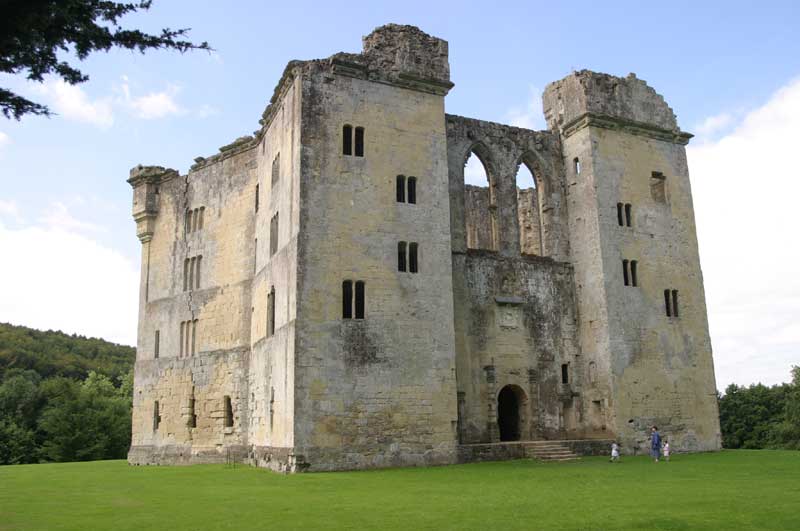
There appear to be some strange connections between the fourteenth century Old Wardour Castle and ancient stone circle Stonehenge.
1: Location
Old Wardour Castle appears to be aligned to ancient sites in the Stonehenge landscape.
2: Alignment
Stonehenge is aligned to the Summer Solstice. Old Wardour has a very similar alignment.
3: Size
Could the builders of Old Wardour used mesaurements from Stonehenge to layout the geometrical keep?
Learn More